5 Website Moves That Turn Dental Office Visitors Into Booked Patients
Your website is either booking patients or losing them
Dental websites fail for one reason: they’re built to look good, not to convert. If your homepage doesn’t answer three questions in the first five seconds (who you serve, what makes you different, how to book), you’re bleeding leads to competitors with sharper sites. These five moves don’t require a full rebuild. Some you can implement this week.
You invested in a website. It looks clean, loads fast, and your team is proud of it. But your call volume isn’t where it should be, and you’re not sure why.
The problem usually isn’t design. It’s structure. Most dental websites are organized around the practice (services, team, history) instead of the patient (problems, outcomes, trust signals). That’s a conversion problem disguised as a design problem.
As a digital marketing agency that’s worked with dental practices across Oregon and Idaho, Just By Design sees this pattern constantly. Here’s how to fix it.
5 Moves That Turn a Dental Website Into a Patient-Booking Machine
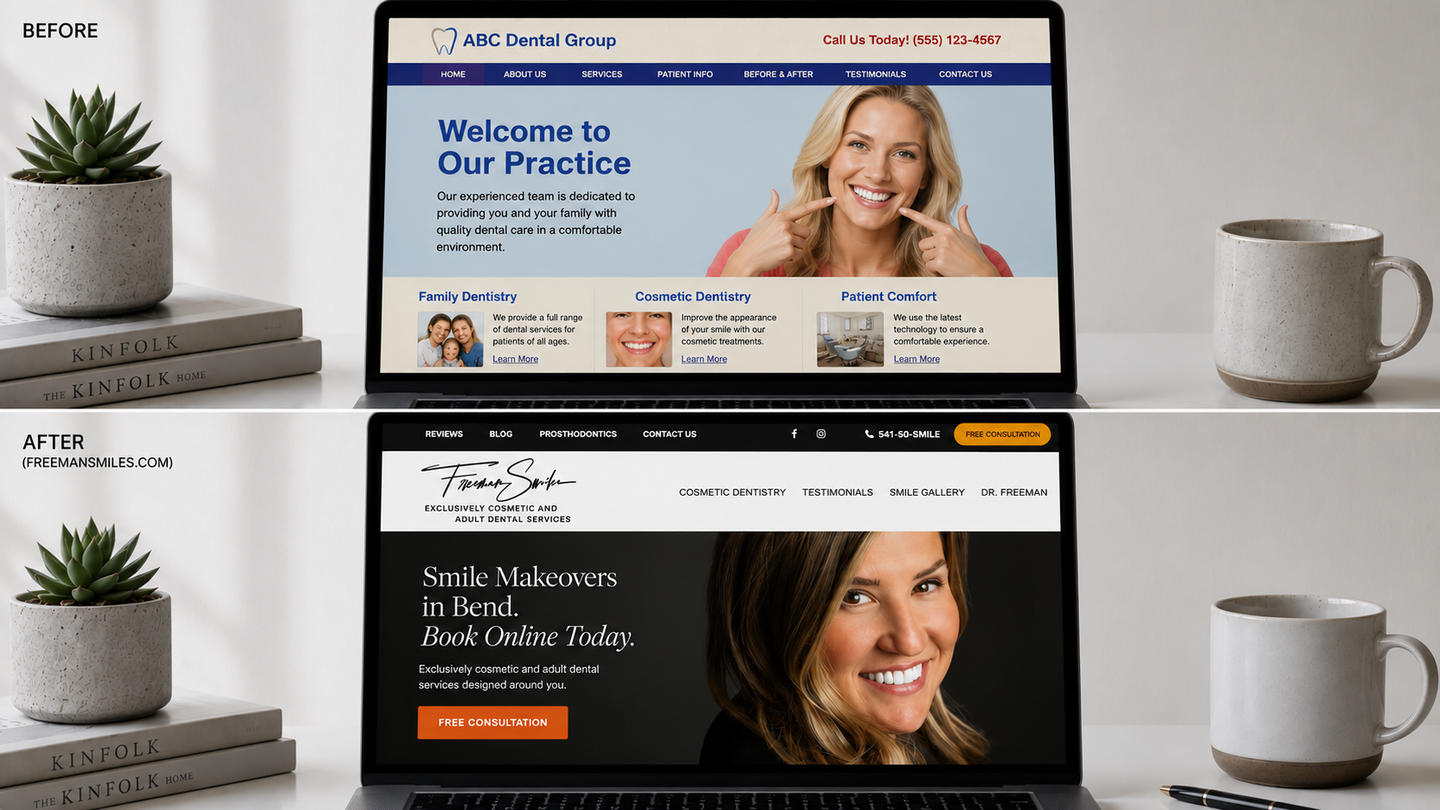
Lead with patient outcome, not practice history
Your homepage hero is the most valuable real estate on your site. Most practices waste it on taglines like “Caring for Your Smile Since 1998.” Patients don’t care when you opened. They care what you can do for them.
Rewrite your hero to lead with the outcome. “Smile Makeovers in Bend, Oregon. Book Online in 60 Seconds.” tells a patient exactly what they’ll get and how easy it is to start.
Test your current hero with the five-second rule: cover the logo, show the homepage to someone who’s never been on your site, and ask what the practice does and who it serves. If they can’t answer in five seconds, the hero needs work.
Use real photography
Stock photography of smiling strangers is a trust killer. Patients considering a new dentist are already anxious. Generic imagery signals that you haven’t invested in showing them who you actually are.
Invest in a professional photo session: the real office, the real team, real patient smiles (with permission). Authentic imagery increases time-on-page, reduces bounce rate, and gives prospective patients confidence before they book.
If budget is tight, even a well-lit smartphone photo of your actual team beats a stock photo of models in lab coats.
Make booking friction disappear
If a patient has to call during business hours to schedule, you’re losing evening and weekend searchers to practices with online booking. That’s a significant slice of new patient volume, especially for working adults.
Minimum standard: a booking button in the header on every page, visible without scrolling. Better standard: online scheduling embedded directly in the site so patients can pick a time without a phone call.
Also audit your contact form. If it asks for more than name, email, phone, and preferred appointment time, cut the rest. Patients abandon long forms.
Differentiate cosmetic and pediatric patient journeys
A parent looking for a pediatric dentist for a seven-year-old and an adult researching veneers have almost nothing in common. Yet most dental websites funnel them through the same homepage and service list.
Create distinct entry points for your major patient segments: “For Adults” and “For Kids” routing to separate service pages with imagery, language, and trust signals tailored to each patient. Cosmetic dentistry deserves its own navigation and messaging.
Segmented journeys reduce friction and increase the relevance of every page visit.
Build trust before the call
Most patients have made up their mind before they pick up the phone. Your website needs to close the sale before you ever talk to them.
Trust signals that work: verified Google review scores prominently displayed, before/after photo galleries, provider bios that read like a person wrote them, and an FAQ that answers the questions anxious patients actually ask.
If you have a case study, publish it. If a patient wrote a detailed review, quote it with their permission. Social proof is the most underused tool in dental websites.
Check your homepage hero right now
Open your website on your phone and look at the first thing you see without scrolling. Ask:
- Does it say what the practice does and who it serves?
- Is there a visible booking button above the fold?
- Is the imagery real (your team, your space) or stock?
- Does the headline lead with patient outcome or practice history?
- Would a new visitor know how to book in under 10 seconds?
If you answered no to two or more, the hero is costing you patients. Fix that first before anything else.
A dental website that converts isn’t about having the most features or the flashiest design. It’s about removing every obstacle between a patient and a booked appointment. Clarity wins. Friction kills.
If you want a second set of eyes on your current site, Just By Design offers a complimentary website review for dental practices in Oregon and Idaho. We’ll tell you exactly what’s working, what isn’t, and what to fix first.
Frequently asked questions about dental office marketing websites
How much does a dental website redesign cost?
Pricing varies significantly based on scope: number of pages, custom photography, integration with practice management software, and online booking. At Just By Design, dental website projects are quoted based on what the practice actually needs, not templated packages. A focused refresh runs differently than a full custom build, and we scope every project individually.
Do I need a dental-specific website or can I use a general website builder?
You can use a general builder, but you’ll hit limitations fast: HIPAA-compliant forms, integration with dental scheduling platforms (Dentrix, Eaglesoft, Open Dental), and local SEO structure all benefit from intentional setup. A builder like Squarespace or Wix gets you a presentable site. Dental-specific needs are better served by a developer who understands both healthcare marketing and technical SEO.
Should my dental website have a blog?
Yes, if you’ll actually maintain it. A blog with consistent, relevant posts (patient education, local health topics, procedure explanations) builds topical authority for Google and AI search engines. A blog that hasn’t been updated in three years signals neglect. Commit to a realistic cadence: even four posts a year is better than abandoning it.
How important is mobile optimization for a dental website?
Critical. Over 60% of local searches happen on mobile, and someone with a toothache at 9pm isn’t searching on a laptop. Your site needs to load fast (under three seconds), have a tap-to-call button, and display the booking option without requiring a pinch-to-zoom. Google uses mobile-first indexing, so a site that works poorly on phones will rank lower across the board.
What pages does every dental website need?
At minimum: Homepage, Services (with individual pages for high-search procedures like teeth whitening, dental implants, and orthodontics), About/Team, New Patients, and Contact with embedded booking. If you serve multiple patient segments (pediatric, cosmetic, restorative), each deserves its own entry point. Location pages are worth adding if you have multiple offices or serve patients from multiple cities.
Related Resources from Just By Design
Ready to build a website that actually books patients?
Just By Design works with dental practices across Bend, Portland, and the Pacific Northwest. We build sites that convert, not just sites that look good. Let’s talk about yours.
Schedule a Free Consult →justbydesign.com · 541.526.3406