
How Dentists Get Found on Google: A Local SEO Diagnostic
Five signals that determine whether your practice shows up in the map pack and organic results when patients are actively searching for a dentist near them.
Get a Local SEO Audit →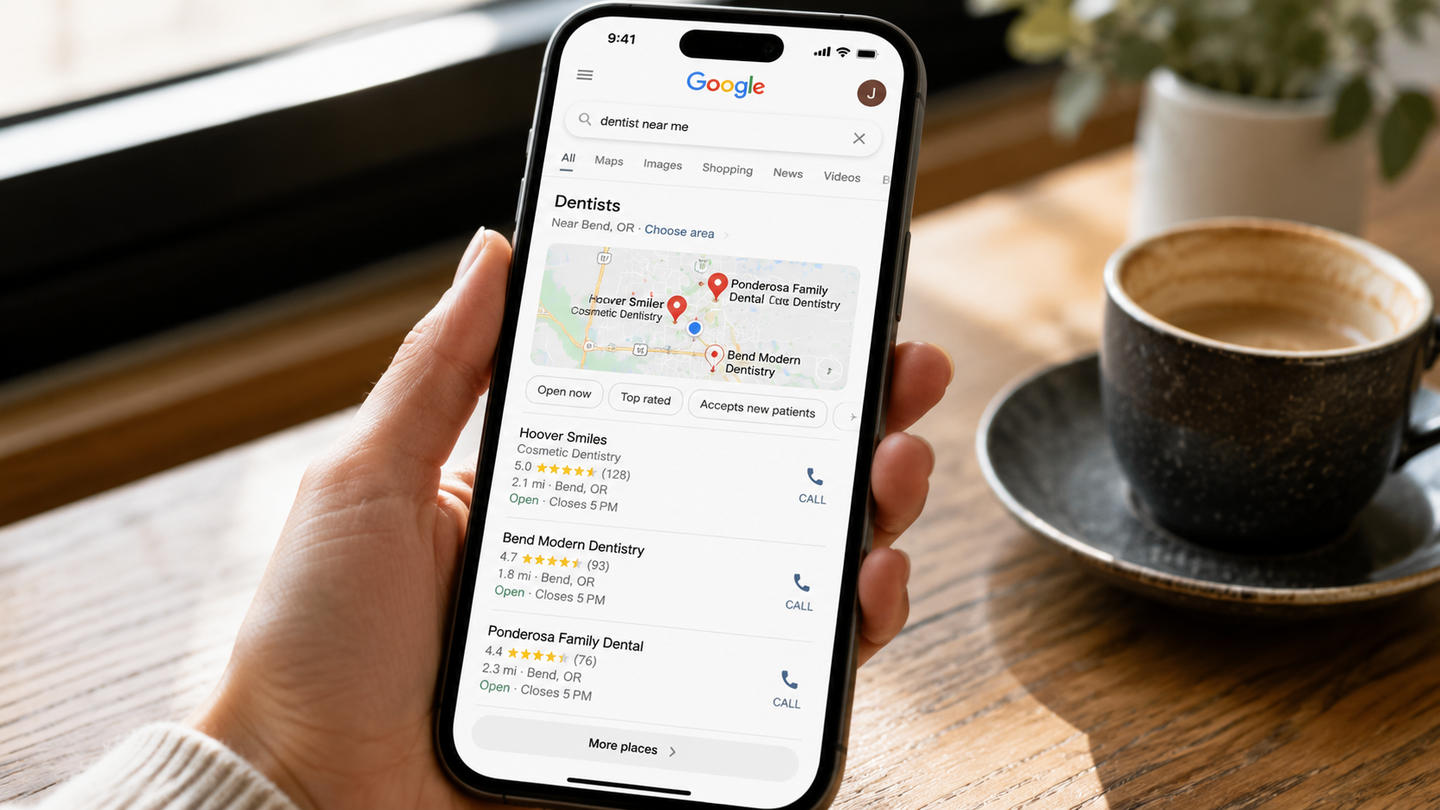
How do dentists get found on Google?
Dentists get found on Google through five compounding signals: a complete and active Google Business Profile, consistent citations across directories, a strong and growing review presence, a website structured for local search, and an AI visibility layer that feeds structured content to platforms like ChatGPT and Perplexity. Practices that show up consistently in the map pack are not lucky. They have built and maintained all five signals over time.
The visibility gap most dental practices do not see
Here is a diagnostic question worth sitting with: when a patient in your city searches “dentist near me” right now, where does your practice appear?
If the answer is anywhere below the top three map results, you are in a visibility gap. Most patients do not scroll. They click one of the top three, read the reviews, scan the website, and schedule. The practice below position three rarely gets the call, even if the clinical quality is equal or better.
The gap is not closed with ads. It is closed with signals, specifically the five signals below that Google and other search platforms use to determine which dental practice deserves the top positions in your market. Each one is diagnosable and fixable.
Just By Design has worked with dental practices across Central Oregon, Portland, and the Pacific Northwest since 2001. This diagnostic reflects what we actually find when we audit a practice’s local search presence, in the order we typically address each signal.
Five signals that determine whether your practice gets found
Google Business Profile: your second homepage
Your Google Business Profile is not an optional listing. For most dental practices, it is the first thing a prospective patient sees, often before they ever visit your website. A fully optimized GBP means: the correct primary category (Dentist, not Medical Clinic or Healthcare), all secondary categories relevant to your services (Cosmetic Dentist, Pediatric Dentist, Orthodontist, etc. as applicable), a complete services section with each procedure named and described, up-to-date hours with holiday schedules, photos updated at minimum quarterly, a complete Products section if you offer clear aligners or whitening, and Q&A responses that pre-answer common patient questions. Practices with incomplete GBPs are essentially handing positions to competitors who did the work.
Local citation consistency: the same information everywhere
A citation is any online mention of your practice’s name, address, and phone number. Google uses citation consistency as a trust signal: if your NAP data matches across every major directory (Yelp, Healthgrades, Zocdoc, WebMD, the ADA directory, your local chamber, and dozens more), Google has confidence that it is recommending the right business at the right location. If the address format varies, the phone number changed two years ago and old listings were not updated, or your practice name appears multiple ways across directories, that inconsistency suppresses your local rankings. Citation audits are not glamorous work. They are foundational. We run them for every new dental client before we touch anything else.
Review volume and recency: the trust signal patients and Google both read
Google reviews serve two purposes: they signal trustworthiness to patients and they signal relevance and authority to Google’s local ranking algorithm. A practice with 200 reviews and a 4.8 star average outranks a practice with 40 reviews and a 4.9 average in most markets, because volume matters alongside quality. More importantly, recency matters. A practice that earned 150 reviews two years ago and has added ten since then is losing ground to competitors with active review programs. A structured, automated review request process sent 24 to 48 hours after each appointment is the single highest-return tactic in local dental marketing for most practices that are not already doing it.
Website structure: built for local search, not just patients
A dental website that ranks locally has location-specific service pages, not a single “services” page trying to rank for twenty things at once. “Invisalign Bend Oregon,” “pediatric dentist Portland,” and “teeth whitening Lake Oswego” are three separate search queries that deserve three separate pages, each with its own keyword focus, content, and local signals. The site should also load fast on mobile, use HTTPS, and have schema markup that explicitly identifies the business as a dental practice at a specific address. The schema layer is what connects the website to the Google Business Profile in the search engine’s model of who you are. Without it, the site and the GBP are two separate pieces of evidence instead of one corroborating signal.
AI visibility layer: showing up where patients are searching next
Patients are increasingly asking AI assistants for dental recommendations before or instead of running a Google search. “Who is a good family dentist in Bend?” asked in ChatGPT gets an answer based on structured content, schema signals, and third-party citations, not paid ads. The AI visibility layer for local dental SEO means the same things that have always mattered in local search (authoritative content, structured data, citations) but optimized for how AI engines extract and synthesize information rather than how search engines rank individual URLs. Practices that build this layer now are creating a compounding advantage that will only grow as AI-assisted search becomes the default for more patient journeys. Deep dive: AI Visibility for Dental Practices: The Complete 2026 Guide
Audit your Google Business Profile this week
Set aside 30 minutes and check your GBP against this list. Fix what you find before spending a dollar on anything else.
- Primary category is set to “Dentist” (not “Medical Clinic” or “Healthcare”)
- All relevant secondary categories are added (Cosmetic Dentist, Pediatric Dentist, Orthodontist, etc.)
- Every service you offer is listed in the Services section with a description
- Photos include exterior, reception, operatory, and team — updated in the last 90 days
- Business hours are current including holiday hours
- Website link goes to the correct page (homepage or specific service page, not a broken link)
- Q&A section has responses to your most common patient questions
Frequently Asked Questions
How do I get my dental practice to rank higher on Google?
Ranking higher on Google for local dental searches requires all five signals working together: a fully optimized Google Business Profile, consistent NAP citations across directories, a strong and growing Google review count, a website with location-specific service pages and schema markup, and increasingly an AI visibility layer that structures content for platforms like ChatGPT and Perplexity. Fixing one signal helps, but the compound effect of all five is where the meaningful ranking improvements happen.
What is a Google Business Profile and why does it matter for dentists?
A Google Business Profile is the listing that appears in Google Maps and the map pack when someone searches for a local business. For dental practices, it is often the first thing a prospective patient sees, before they visit your website. It shows your hours, reviews, photos, location, and services. An incomplete or inaccurate GBP suppresses your local rankings and loses patients to practices that did the setup work correctly.
How important are Google reviews for dental practices?
Extremely important, for two reasons. First, they are a direct trust signal for patients: most people read reviews before scheduling with a new dentist, and both volume and star rating affect whether they call. Second, Google uses review quantity and recency as a local ranking signal. A practice with consistent review growth outranks a practice with a static review count, even if the static one has a higher average rating.
How long does local SEO take to work for a dental practice?
A complete GBP can show ranking improvements within 30 to 60 days of being properly set up. Citation cleanup shows movement within 60 to 90 days as directories update. Service page content typically shows keyword movement in 90 to 180 days. Review growth compounds over time. The practices that invest consistently in all five signals for 12 to 18 months report local SEO as their highest-return marketing channel.
Should dental practices use paid Google Ads or focus on organic local SEO?
Both have a role, but sequence matters. Local SEO builds a foundation that compounds: every review, every citation, every content piece you publish today still pays dividends a year from now. Paid ads stop the moment you stop paying. Most dental practices get better long-term ROI by building the organic local SEO foundation first, then using Google Ads to accelerate results on high-value procedures once the foundation is in place.

Keep reading
More on this topic from the Just By Design blog.

Marketing for Dental Practices: A Strategic Blueprint
The full four-pillar framework. Local SEO is Pillar 03.

AI Visibility for Dental Practices: The Complete 2026 Guide
How to structure your practice so ChatGPT and Perplexity recommend you by name.

How Much Should a Dental Practice Spend on Marketing?
A four-layer budget framework with benchmarks for practices at every stage of growth.
Want to know where your practice stands in local search?
Schedule a free local SEO audit with Justine. We will run through all five signals and tell you exactly what needs attention first.
Schedule a Free Consult → justbydesign.com · 541.526.3406