
Cosmetic Dentistry Marketing: Four Moves That Actually Differentiate Your Practice
Generic dental marketing blends into the background. Positioned cosmetic dentistry marketing attracts patients who are already sold on what you do before they ever call.
Get a Positioning Audit →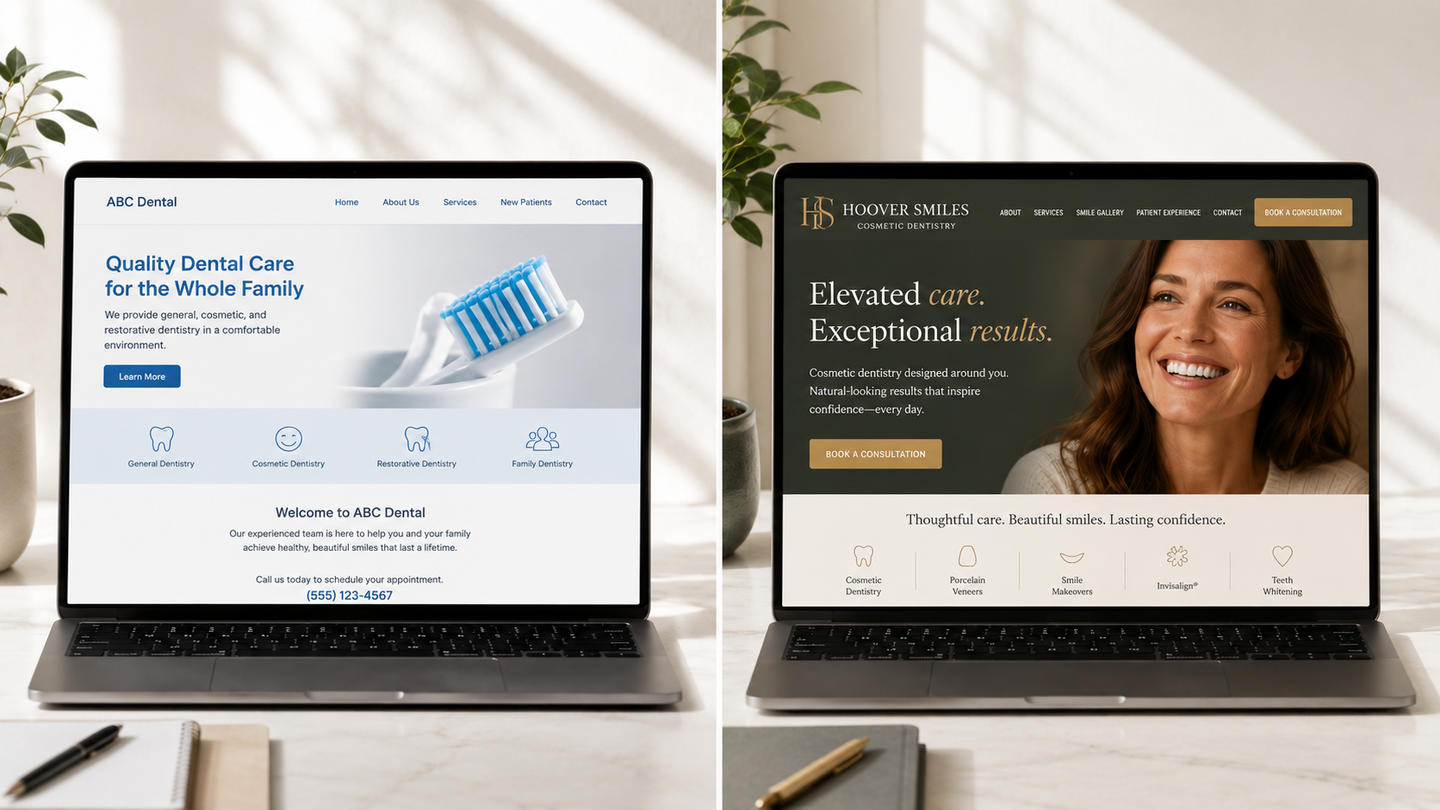
What makes cosmetic dentistry marketing actually work?
Cosmetic dentistry marketing works when your practice has a clear specialty lane, a visual identity that matches the patients you want to attract, a voice that feels specific and confident instead of clinical and generic, and a website that uses real patient results to prove your work before anyone calls. Most cosmetic practices make the mistake of marketing broad. The ones that grow fast market specific.
Why most cosmetic dental marketing looks the same
Pull up ten cosmetic dentistry websites at random and you will find nearly identical content: “A beautiful smile starts here.” “We offer Invisalign, veneers, whitening, and more.” “Schedule your complimentary consultation today.”
Nothing in that content is wrong. All of it is forgettable.
Patients choosing a cosmetic dentist are making a high-investment, high-trust decision. They are comparing practices the same way they compare any luxury purchase: by looking for signals that a specific practice is the right one for them specifically, not just a capable option. Generic marketing fails this test completely. It says, “we do cosmetic dentistry.” It does not say, “we are the practice for the kind of patient you are.”
The four moves below are what separate positioned cosmetic dentistry marketing from the undifferentiated majority. Each one is concrete and executable, not theory.
Generic approach vs. positioned strategy: what the difference looks like
| Generic Approach | Positioned Strategy |
|---|---|
| Headline“A beautiful smile starts here” | Headline“Portland’s destination for full-mouth smile design and reconstruction” |
| Services“We offer Invisalign, veneers, whitening, implants, and more” | ServicesEach service has its own page, keyword target, before-and-after gallery, and FAQ |
| Visual identityStock photos, blue palette, clip art smiles | Visual identityReal patient photography, brand palette that signals the practice’s personality |
| Social proofStar rating on Google, generic “great staff” reviews | Social proofCase-specific reviews with procedure names and patient outcomes |
| CTA“Schedule a consultation” | CTA“Book your smile design consultation” with a specific outcome promise |
Four moves that differentiate a cosmetic dental practice
Define your specialty lane
Cosmetic dentistry covers a broad range of services. Most practices offer all of them. The ones that dominate their market have picked a lane and gone deep. That might be full-mouth reconstruction and smile design for adults who want a dramatic transformation. It might be clear aligner therapy for professionals in their thirties and forties. It might be cosmetic bonding and conservative aesthetics for patients who want natural-looking results without crowns. The lane does not have to be narrow, but it has to be specific enough that a patient landing on your site or finding you on Google can say, “yes, this is the practice for what I want.” Specificity is not limiting. It is magnetic.
Match your visual identity to the patient you want to attract
Cosmetic dentistry is a visual service. Patients are deciding with their eyes before they read a word of copy. A practice that uses stock photos of generic smiles, blue-and-white healthcare templates, and clip art-adjacent imagery is telling patients nothing about what it is like to be treated there. A practice that uses real patient photography, a visual palette that signals its personality (refined and high-end, warm and approachable, or modern and clinical), and consistent design across website, social, and printed materials is communicating before a word is read. Just By Design has been doing this kind of brand-aligned dental design since 2001. The practices that invest in real visual identity see higher-quality inquiries and lower cost per new patient.
Give your practice a distinct voice
Most dental websites sound like they were written by the same person, because they were: a dental copywriting service that writes for every practice in every city. The voice is clinical, passive, and generic. “Our team of experienced professionals is committed to providing exceptional care in a comfortable environment.” It means nothing. A positioned cosmetic dental practice has a voice that sounds like a specific person with a specific point of view. That might be direct and confident: “We do not do mediocre. If you want veneers that look like veneers, we are not your practice.” It might be warm and reassuring: “Most of our patients were nervous before their first visit. Almost none of them were nervous by the time they left.” Voice is what makes a patient feel like they found their dentist, not just a dentist.
Turn your website into proof of your positioning
The website is where positioning either earns its keep or falls apart. A cosmetic dental website built around positioning has dedicated service pages that rank for the procedures patients are searching for (not a single “cosmetic dentistry” page trying to rank for ten things at once), a before-and-after gallery organized by procedure with real patient captions, treatment-specific FAQs that answer the questions Google is already surfacing for those procedures, and a consultation page that sets expectations for what the first visit looks like. Every element should reinforce the specialty lane, visual identity, and voice established in Moves 01 through 03. The website is not a brochure. It is the proof that your positioning is real.
Just By Design works with cosmetic dental practices across Bend, Portland, Lake Oswego, and Central Oregon. Every engagement starts with a positioning audit before we touch a single page of the website, because the site built on a clear position converts at a meaningfully higher rate than the site built on good design alone.
Frequently Asked Questions
What is the best marketing strategy for a cosmetic dental practice?
The best marketing strategy for a cosmetic dental practice starts with positioning: defining a specialty lane, aligning visual identity to the patient you want to attract, developing a distinct voice, and building a website that proves your positioning with real patient results. Most cosmetic practices market too broadly and blend in. The ones that grow fastest market specific and stand out.
How do cosmetic dentists get more patients?
Cosmetic dentists get more patients by being easy to find and easy to trust at the same time. That means showing up on Google for procedure-specific searches (“veneers Portland” or “Invisalign Bend”), having a website with real before-and-after photography and case-specific reviews, and maintaining a Google Business Profile that reflects the quality and personality of the practice. High-value cosmetic patients research extensively before scheduling. Every touchpoint has to earn their trust.
Do cosmetic dental practices need social media?
Yes, with the right focus. Cosmetic dentistry is inherently visual, which makes Instagram and Facebook genuinely useful channels. The key is using real patient results (with consent) rather than stock content. Before-and-after posts, short videos of transformation processes, and patient testimonials outperform generic dental tips by a wide margin. Post consistently rather than perfectly, and always link back to the relevant service page on your site.
How do you write content for a cosmetic dentistry website?
Write for the patient you want, not the search engine you are trying to rank on. Each major service (veneers, Invisalign, whitening, implants, full-mouth reconstruction) deserves its own dedicated page with a clear headline, the procedure explained in plain language, answers to the questions patients actually ask, real patient results, and a specific CTA. Avoid generic phrasing. Be specific about what you offer, who it is for, and what outcome they can expect.
What makes a cosmetic dental website convert?
Cosmetic dental websites convert when they answer the four questions every high-investment patient is silently asking: Is this practice any good? Do they do the specific thing I want? Do real patients like them? What happens if I reach out? Real photography, case-specific testimonials, dedicated procedure pages, and a friction-free booking path answer all four. Generic stock photography and a single contact form answer none of them.

Keep reading
More on this topic from the Just By Design blog.

Marketing for Dental Practices: A Strategic Blueprint
The full four-pillar framework. Positioning is Pillar 01.

The Dental Website That Converts
Five design and content moves that turn website visitors into scheduled patients.

How Dentists Get Found on Google: A Local SEO Diagnostic
Five signals that determine whether your practice shows up when patients are searching nearby.
Ready to stop blending in?
Schedule a free positioning audit with Justine. We will identify your specialty lane and show you exactly what it takes to market it.
Schedule a Free Consult → justbydesign.com · 541.526.3406