AI Search & Visibility
AI SEO vs Traditional SEO: What’s Actually Different
If you already understand SEO, this article explains exactly where AI search requires a different strategy — and where the overlap is greater than you might expect.
By Justine Kingston | Just By Design | Serving Oregon, Washington & beyond
Why This Comparison Matters Right Now
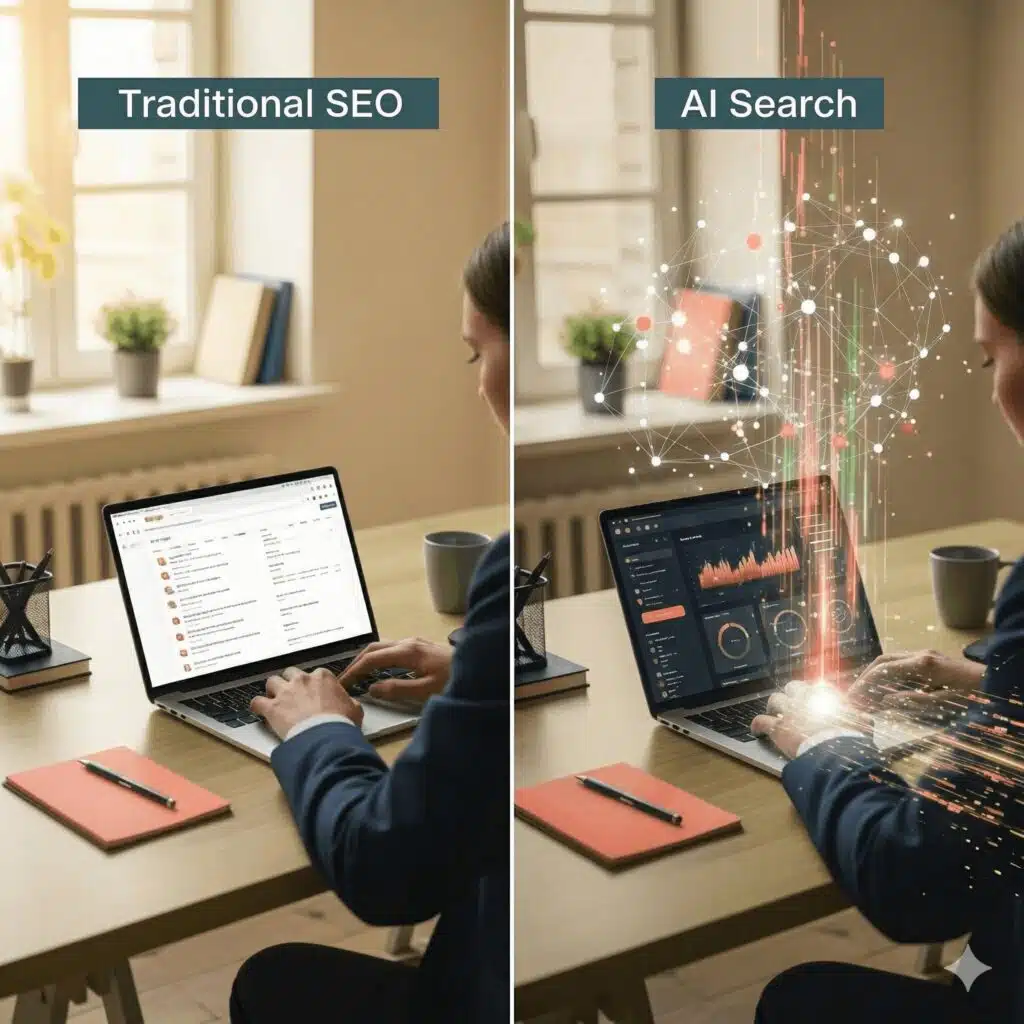
Most businesses, including most marketing agencies, are still operating with a traditional SEO framework as their primary strategy. That framework was built for a world where search means: user types query, search engine returns list of links, user clicks the most relevant result.
That world still exists. But alongside it, a parallel search behavior has emerged: user asks AI a question, AI generates a direct answer that may or may not include citations, user acts on the answer. In this scenario, traditional SEO optimization may have zero impact on whether your business is mentioned.
Understanding the difference is not about abandoning what works. It is about extending your strategy to cover the growing share of searches that never touch a traditional results page.

Side-by-Side: Traditional SEO vs AI SEO
| Dimension | Traditional SEO | AI SEO (GEO) |
|---|---|---|
| Primary goal | Rank in search results (position 1–10) | Be cited in AI-generated answers |
| Success metric | Keyword ranking, organic traffic | Citation frequency, brand mention accuracy |
| Core optimization signal | Keyword relevance + backlinks | Entity clarity + content structure |
| Content format priority | Keyword-optimized prose | Direct answers, FAQ, structured definitions |
| Technical priority | Crawlability, page speed, Core Web Vitals | Schema markup, structured data, entity signals |
| Authority measurement | Domain authority, link profile | Entity authority across the web |
| User behavior | Click to visit site | Answer consumed — click may not happen |
| Time to results | 3–6 months typical | 6–18 months for authority to compound |
| Geographic targeting | Local SEO, geo-targeted keywords | Entity + schema-based geographic signals |
What Traditional SEO Still Gets Right
The good news for anyone with existing SEO investment: many traditional SEO fundamentals still apply, and doing them well supports AI visibility too.
| Fundametals | What It Means |
|---|---|
| Technical site health | A fast, crawlable, well-structured site is the foundation for both traditional and AI search |
| Quality content | Substantive, well-researched content outperforms thin content in both contexts |
| Backlinks and citations | External authority signals matter for both Google rankings and AI citation patterns |
| E-E-A-T | Experience, Expertise, Authoritativeness, Trustworthiness is a shared concept; Google’s E-E-A-T guidelines translate directly into AI citation criteria |
What AI SEO Requires That Traditional SEO Doesn’t
This is where the strategies diverge. AI SEO requires intentional investment in areas that traditional SEO has historically underemphasized:
Entity-First Thinking
Traditional SEO is keyword-first. You identify what terms people search, then optimize pages for those terms. AI SEO is entity-first. You define who your brand is, what it does, and what concepts it is associated with — and then make sure those definitions are clear, consistent, and machine-readable. Read more: Entity SEO Explained.
Schema as a First-Class Priority
Schema markup has always been beneficial for traditional SEO — but it has been optional. For AI visibility, it is essential. Organization, Person, Article, FAQ, and Service schema collectively tell AI systems who you are and what you offer in unambiguous terms. See the full implementation guide: Schema for AI Search.
Defining Your Brand Concept Explicitly
AI systems cite sources that clearly define concepts. If your website never explicitly states what you do in clear, quotable language — if it is all implied rather than stated — AI systems cannot confidently summarize or recommend you. Every key page needs a definition or direct answer in its first paragraph.
Off-Site Citation Footprint
Traditional SEO focuses on backlinks for ranking authority. AI SEO additionally requires brand mentions, topic association in external publications, and presence in knowledge databases. Being cited by name in a guest article on a marketing website carries AI authority value that a plain backlink does not fully replicate. See: LLM Citation Optimization.
Content Written to Be Cited, Not Just Read
Traditional SEO content is written to rank and to engage readers. AI SEO content is also written to be directly extracted — to provide a clean, accurate, quotable answer that an AI can pull verbatim or near-verbatim. This changes how you open sections, how you write definitions, and how you structure FAQ entries. See: How to Structure Content for AI Search.
The JBD AI Visibility Framework: Bridging Both
The JBD AI Visibility Framework is designed to integrate both disciplines. Its six pillars — Entity Clarity, Structured Authority, Citation Architecture, Content Hierarchy, Knowledge Graph Signals, and External Authority — cover the AI-specific requirements while building on the traditional SEO foundation your site already has.
For businesses with mature traditional SEO, the framework adds the AI layer without discarding existing investment. For businesses starting fresh, building AI-first produces results in both channels simultaneously.

Which Should You Focus On?
The answer depends on where you are starting:
Strong traditional SEO already in place?
Add the AI layer: schema, entity signals, FAQ content, off-site citation building. Your existing authority accelerates the AI strategy.
Starting from scratch or rebuilding?
Build AI-first. An AI-optimized foundation also satisfies traditional SEO fundamentals — you get both from the same investment.
Limited resources?
Prioritize schema markup and content restructuring. These have the highest impact-to-effort ratio across both channels.
Frequently Asked Questions
Is AI SEO replacing traditional SEO?
Not replacing, evolving. Traditional SEO fundamentals like technical site health, quality content, and backlinks still matter. But AI SEO adds a new layer of priorities: entity definition, structured data, direct-answer formatting, and off-site citation building. Businesses need both.
What is the difference between ranking in search results and being cited in AI answers?
Ranking in traditional search results means appearing in a numbered list of links. Being cited in an AI answer means your business or content is included in the AI’s generated response, often without requiring the user to click. AI citations generate brand awareness and trust even in a zero-click scenario.